I am quite sure most of you know what neuroplasticity is and what it means, but here is my take on it. When I first read about this, it pretty much blew my mind. How incredible this inherent capability we all have really is. And how it matters in so many situations throughout our lives. We need to view neuroplasticity through a simple hope-versus-hype lens. This gives us a clearer perspective. My personal thoughts are that hope (really) is way larger than the hype. However, the hard work required to trigger it tends to be ignored, causing the hype to increase past the hope.
Now, as you read this sentence, thousands of microscopic workers in your brain are busy laying down new pathways, strengthening connections, and literally reshaping your neural architecture. They don’t care if you’re learning calculus or doom-scrolling social media—they’re just following orders. The question is: who’s giving those orders?
The Good: Your Brain’s Incredible Renovation Crew
Picture your brain as a bustling construction site where tiny hard-hatted workers never clock out. When you decide to learn Spanish, these neural construction crews spring into action, building highways between language centers. When stroke survivors relearn to walk, those same construction workers in your brain assist the healthy brain regions to literally rewire themselves to take over damaged areas—like having backup generators kick in during a power outage.
This is neuroplasticity at its most magnificent. A taxi driver’s hippocampus (important part of the brain) actually grows larger from navigating London’s maze-like streets. Musicians develop expanded motor cortex areas (controls voluntary movement) for their instrument-playing fingers. Even in our 80s, our brains can forge new connections, proving that “you can’t teach an old dog new tricks” is neuroscientific nonsense.
However, neuroplasticity isn’t instant. It takes time — days, weeks, or even months. The brain needs repetition and emotional weight (like reward or meaning) to reshape itself. Sleep, exercise, and focused practice help the process.
A Day in the Brain Factory: The Plasticity Chronicles
Let’s step inside the brain factory during a crucial learning session. Picture this scene as a movie—it’ll help explain everything that follows.
8:47 AM – The Control Room
Brain Boss sits behind a wall of monitors, coffee in hand, watching the morning shift begin. Red warning lights suddenly flash across the main dashboard.

Brain Boss: “What’s the commotion down there?”
Foreman Rodriguez bursts through the door, hard hat askew, blueprints scattered. “Boss! Emergency situation in Sector 7. The human just opened a calculus textbook!”
Brain Boss: (sighs) “Here we go again. What’s the chemical readout?”
Foreman Rodriguez: “That’s the thing, Boss. This time feels different. Stress hormones are spiking, but it’s focused stress. They’ve got that big exam in two weeks, and they really care about passing.”
Brain Boss: “Epinephrine levels?”
Foreman Rodriguez: “Climbing fast! The human’s genuinely worried about failing. Fear’s a powerful motivator, Boss. It could get hairy.”
Through the control room’s glass wall, they watch thousands of tiny workers scrambling around mathematical pathways that look dusty from disuse.
Brain Boss: “Attention systems—what’s the status?”
Foreman Rodriguez: “This is where it gets interesting. Phone’s in the other room. Music’s off. Eyes are locked on those equations like a laser. The Acetylcholine Spotlight Team is going crazy—they’ve never had such a clean signal to work with.”
9:15 AM – Down on the Factory Floor
Worker #47 wipes sweat from her tiny brow as she reinforces a connection between “derivative” and “rate of change.”

Worker #47: “Hey! This pathway hasn’t been used since high school! It’s all overgrown!”
Worker #23: “Orders from the top! Boss says to clear it out and strengthen it. Apparently, the human actually cares this time.”
Worker #47: “How do we know they really care?”
Worker #23: “Look at the chemical readout!” points to glowing green numbers on a nearby monitor “Epinephrine through the roof, acetylcholine spotlight is pinpoint accurate, and—get this—the deep brain acetylcholine from nucleus basalis just kicked in!”
Worker #47: “No way! All three signals? At the same time?”
Worker #23: “All three! You know what that means…”

Both workers cheer: “PLASTICITY PROTOCOL ACTIVATED!”
10:30 AM – Back in the Control Room
Alarms are ringing, but they’re the good kind—like a ship’s bell announcing victory.
Foreman Rodriguez: “Boss! The workers are requesting permission to flag these calculus pathways for tonight’s reconstruction project.”
Brain Boss: “Granted. But remind them—no actual rewiring until sleep mode. Day shift only identifies and marks. Night shift does the heavy construction.”
Foreman Rodriguez: “Copy that. But Boss… the workers are exhausted. They’re saying this is the hardest they’ve worked in months.”
Brain Boss: “Good. That agitation, that mental fatigue—that’s how we know it’s working. Easy doesn’t trigger change. Tell them to hang in there for another hour.”
11:45 AM – Study Session Ends
The human closes the textbook and stretches. Down on the factory floor, workers are tagging neural pathways with bright yellow flags.
Worker #47: “Okay, I’ve marked the derivative pathway, the chain rule connection, and that tricky integration by parts section.”

Worker #23: “Night shift is going to be busy. These flags tell them exactly where to strengthen connections and which old pathways to prune away. That’s a lot of flags, man.”
Foreman Rodriguez: (over loudspeaker) “Attention all workers! Day shift complete. Rest protocols now in effect. Do NOT attempt major construction until sleep mode activates. That’s when the real magic happens.”
11:00 PM – Night Shift Takes Over
The factory transforms. Day workers rest while night crews emerge with heavy machinery and reconstruction tools.
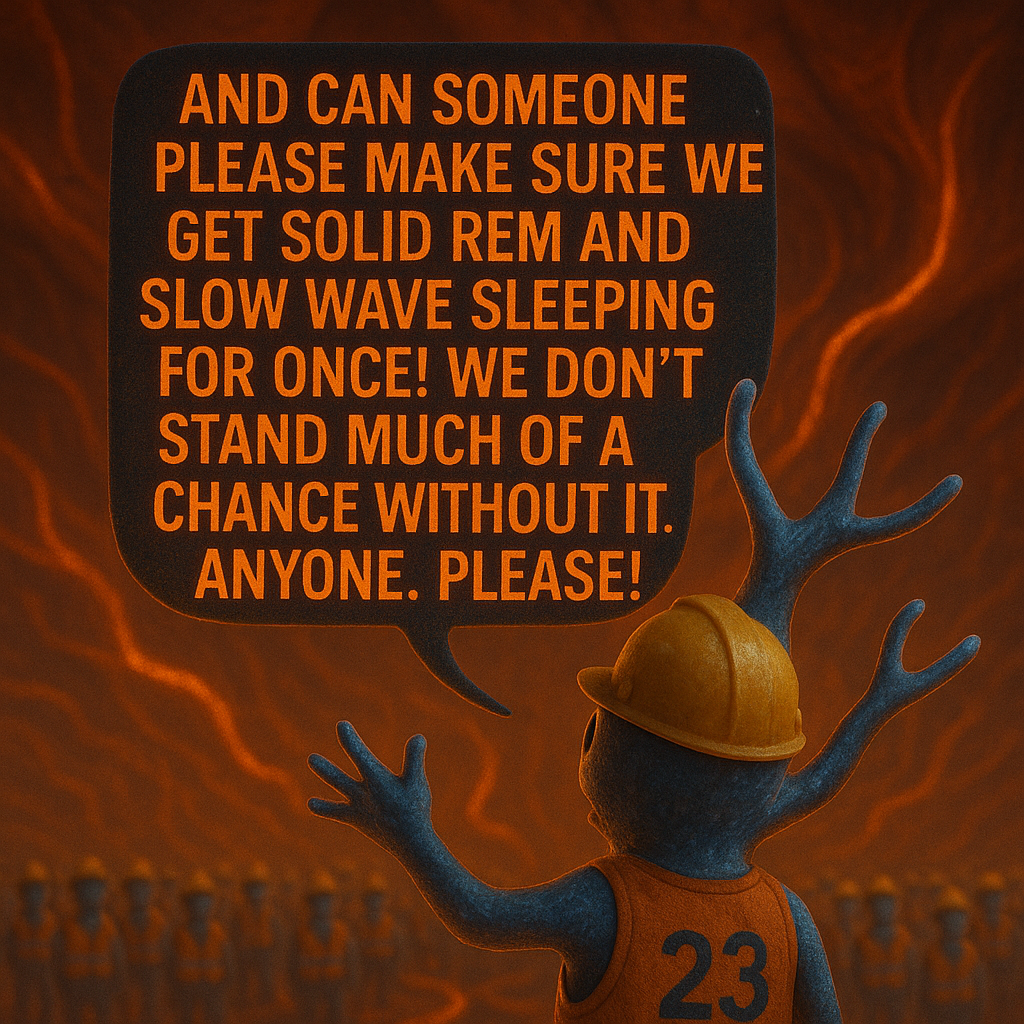
Night Foreman Chen: “Alright, crew! We’ve got yellow flags throughout the math sector. Day shift did good work—strong emotional investment, laser focus, proper chemical signals. Time to make these changes permanent.” he turns around and shouts to the back “And can someone please make sure we get solid REM and Slow Wave sleeping for once! We don’t stand much of a chance without it. Anyone. Please!”
Teams of night workers begin the delicate process of strengthening synapses, pruning unused connections, and consolidating the day’s learning into long-term neural architecture.
Brain Boss: (yawning) “Beautiful work, everyone. When the human wakes up tomorrow, those calculus concepts will be wired in deeper than before. They won’t even realize we’ve been working all night.”
This scene plays out millions of times across your lifetime. However, not for math specifically in your case. Sometimes the workers get confused signals. Sometimes the human doesn’t provide enough focus or emotion. But when everything aligns—alertness, attention, repetition and genuine care—the brain’s construction crews perform miracles.
The Bad: When Your Brain Becomes Your Own Worst Enemy
But here’s where the story takes a darker turn. Those same diligent workers don’t discriminate between helpful and harmful patterns. They are completely neutral. They simply respond to repetition with mechanical efficiency.
Every time you check your phone anxiously, the workers dutifully strengthen that pathway. Every “I’m not good enough” thought loop gets reinforced like a forest trail walked daily—eventually becoming a superhighway to self-doubt. Your brain becomes really, really good at worrying, overthinking, or whatever destructive pattern you’ve accidentally trained it on.
The Brain Boss scratches his head: “Who authorized this anxiety loop? We’ve built it into a six-lane highway, but it only leads to a dark cave!”
This is neuroplasticity’s cruel irony: the same mechanism that helps us heal can trap us in cycles of pain.
The Interesting: Your Brain’s Strange Quirks and Surprises
Neuroplasticity produces some genuinely bizarre phenomena. Take phantom limb syndrome, where amputees feel sensation in missing limbs—their brain maps haven’t caught up with reality. The pain they might experience could be generated from a completely different part of the body that has remapped to the phantom limb’s former location in the brain.
Perhaps most intriguingly, your brain can be tricked into change. Simply imagining yourself practicing piano can strengthen the same neural pathways as actual practice, though less effectively. Mental rehearsal literally reshapes your brain.
Even more fascinating: your brain workers operate on a “use it or lose it” principle. Stop speaking a second language, and those pathways gradually weaken. But they don’t disappear entirely—they lurk like overgrown forest trails, ready to be cleared again with practice.
The Not So Probable: Separating Hype from Hope
Despite what self-help gurus claim, neuroplasticity isn’t a magic bullet. You probably can’t train yourself to have a photographic memory or become a mathematical genius overnight. The brain’s flexibility has limits, especially as we age. We also need to acknowledge the genuine limitations of genetics, trauma, and neurological conditions.
Critical periods matter. A child can recover from brain damage that would permanently disable an adult. Learning perfect pronunciation in a new language becomes nearly impossible after puberty. While your brain remains plastic throughout life, it’s more like switching from soft clay to hardening plaster—still moldable, but requiring much more force. The optimal neuroplasticity time period for humans is up to the age of 25. Then it starts to drop off slightly over the years, making it slightly harder to enter that plasticity state. This does not mean it is gone! Just a little harder. For all of you below the age of 25: go learn stuff! It will never become easier than now.
Quality of practice matters more than quantity. Your brain workers respond better to focused, challenging practice than mindless repetition. The challenging part is where repeating the same cognitive training game gets less effective than actually being presented with a new situation.
The Science Behind: What’s Really Happening in There
Here’s the truth that most people miss: your brain adapts. It’s not fixed; it’s a living, changing system that reshapes itself based on what you repeatedly do, think, and feel. With emphasis on the repeated part.
But change doesn’t happen from casual experience. Most people think every lecture, every conversation, every scroll through social media is rewiring their brain. However, your brain will only change when specific neurochemical conditions are met—and those conditions require work.
The brain workers need three chemical signals to start renovations:
Epinephrine (alertness): You must be genuinely alert and focused, not just passively consuming information. This comes from caring deeply about what you’re learning—whether from love, fear, excitement, grit, or even accountability pressure.
Acetylcholine from the brainstem (attention spotlight): Your attention must be laser-focused on exactly what you want to change. Scattered attention creates scattered results. When researchers had people touch bumps on a spinning drum while paying attention to sounds instead, only the auditory areas changed—not the touch areas.
Acetylcholine from nucleus basalis in the basal forebrain: This deeper brain region must also release its chemical signal, which happens when the first two conditions are met with sufficient intensity.
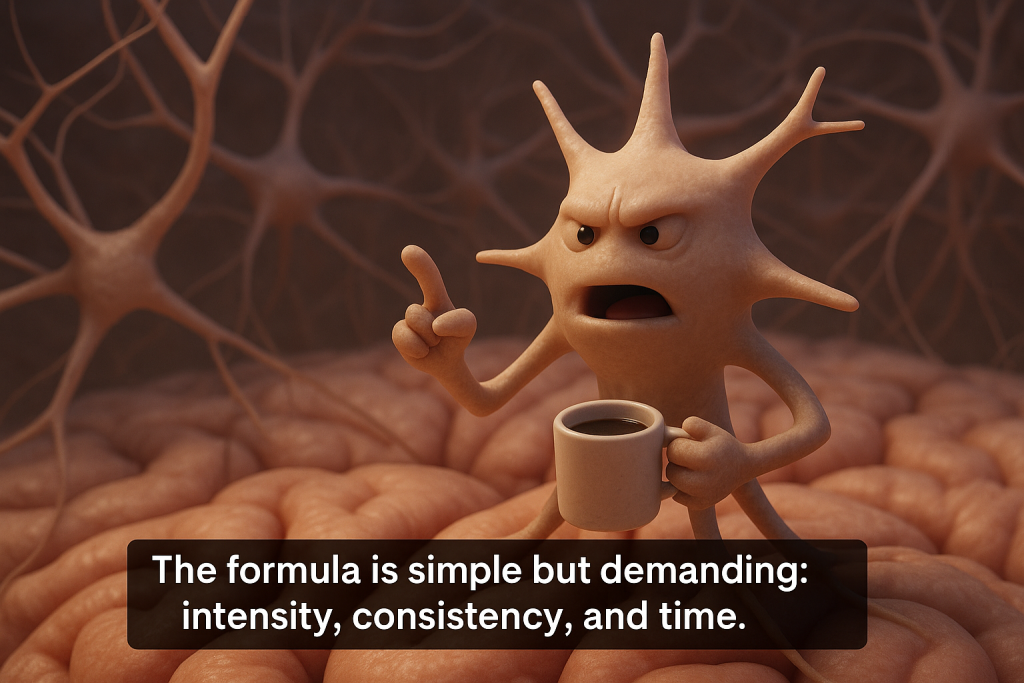
The formula is simple but demanding: intensity, consistency, and time.
The key ingredients are:
- Repetition (do it a lot—focused practice, not mindless repetition)
- Emotion (care about it deeply—your brain prioritizes what matters to you)
- Rest (let the brain replay it during sleep and recovery)
A really important aspect of this is that most people (especially young people) fail to trigger the plasticity state because they’re not alert enough, not focused enough, or not emotionally invested enough. The agitation you feel when trying to concentrate? That’s epinephrine working. The difficulty in maintaining focus? That’s your brain workers asking, “Are you sure this is important enough to rebuild for?” Personally, I think the ’emotionally invested’ piece is a major player in today’s world.
Who’s Really in Charge?
Neuroplasticity is often praised like a superpower — and in many ways, it is. But like any power, it needs guidance. The very flexibility that helps us grow can also lock us into loops of pain or distraction. That’s why understanding how it works — not just celebrating its magic — is so important.
By using metaphors like the Brain Boss and the brain workers, we see how impersonal, automatic, and mechanical the brain’s habits can be. It reminds us that we can influence this system by choosing where to focus and what to repeat. The workers don’t resist change — they just need instructions.
In a world full of distractions and stress, it’s comforting to know that we can reshape our inner world — not overnight, but with steady steps, the brain becomes what we train it to become.
So we return to our opening question: who’s giving orders to your brain’s construction crew? The uncomfortable truth is that much of the time, no one is. Your neural workers respond to whatever patterns you feed them, consciously or not.
But here’s the empowering part: awareness changes everything. Once you understand that your brain is constantly rewriting itself based on your repeated thoughts, actions, and focus, you can start giving better directions. You can choose which pathways to strengthen and which to let overgrow.
Your brain is rewriting itself right now as you finish reading this. The question isn’t whether neuroplasticity is good or bad—it’s whether you’ll take conscious control of the renovation project happening between your ears.
The Brain Boss is waiting for your instructions. What will you have your workers build today?
Neuroplasticity – Definition
Malleability; quality of dynamically changing in response to environmental or developmental factors or in response to damage. (Cognitive Neuroscience, 5th edition)